
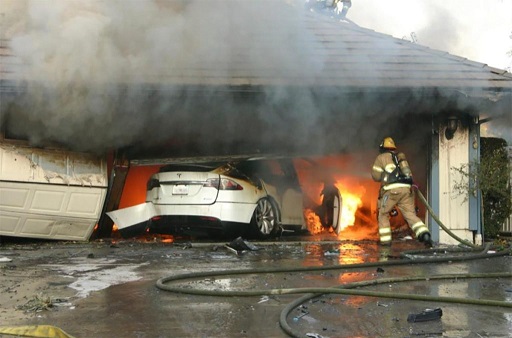
More EV Charging Fire Woes: “batteries can reignite hours or even days after they were initially extinguished”
By B.N. Frank
Most people seem to be aware that electric vehicle (EV) batteries (including for E-Bikes) have been catching fire and exploding – sometimes while being charged – and that there have been numerous recalls to address this issue (see 1, 2, 3, 4, 5, 6, 7). In fact, last month the National Highway Traffic Safety Administration (NHTSA) announced it had started investigating safety defects in EV batteries. Of course other health and safety issues have been associated with EVs too (see 1, 2, 3). As if the fires aren’t bad enough!
From News Target:
Electric vehicle charging causes house fires that result in substantial losses
Electric vehicle (EV) charging has caused several house fires and resulted in massive losses, with three such fires being recorded in the states of Virginia and Maryland.
A March 31 house fire in Damascus, Maryland caused by a charging EV resulted in $350,000 worth of damages. It also displaced four people and a few pets the individuals owned. One person in the house had to be rescued, but no injuries were reported.
Pete Piringer, spokesman for the Montgomery County Fire and Rescue Service (MCFRS), said the fire started in the house’s garage near the front end of a Chevrolet Volt that was charging. The hybrid vehicle runs primarily on an electric battery that needs charging. When the battery uses up energy to a certain point, its gasoline-powered engine operates an electric generator to extend its range.
On April 5, another fire broke out at an apartment located in the city of Bethesda in Maryland. The blaze caused by a charging scooter displaced three people and resulted in about $150,000 worth of damages. One resident suffered minor burns.
According to Piringer, MCFRS firefighters responded to the scene after they saw smoke coming out of a unit on the third floor. They managed to extinguish the blaze almost half an hour later. Piringer added that a lithium battery inside an electric scooter that overheated caused the conflagration. (Related: Latest lithium-ion battery uses water-salt solution, reducing risk of fire and explosion in household electronics.)
Almost two weeks later, a garage at a home in Ashburn, Virginia caught fire on April 18. Firefighters from the Loudoun County Fire and Rescue responded to a 911 call for smoke visible from the garage. The owner and other individuals in the house managed to escape the blaze that caused $15,400 in damages.
The county’s fire marshal ruled the blaze accidental, adding that it originated from the electric vehicle charging in the garage. The vehicle’s charging system malfunctioned, which caused the garage fire.
EVs touted as the green transport solution despite their risks
Abby Liebing, an associate reporter for the Western Journal, wrote about the three home fires caused by the EVs being charged.
“These are not terribly remarkable events. The damages are unfortunate, but not catastrophic,” she noted. “As EVs become more common, the risk of fires associated with [them] cannot be overlooked or underplayed.”
A CNBC report that quoted a study by vehicle insurer AutoinsuranceEZ said hybrid EVs have a 3.4 percent chance of igniting. Conventional battery EVs only have a 0.03 chance of igniting, while internal combustion engines powered by fuel have a 1.5 percent chance of catching fire.
The same report added that EVs using lithium-ion batteries burn hotter and faster when they catch fire. Such fires require more water to extinguish, with Liebing citing an example of one such conflagration. A fire from a Tesla EV that crashed in Houston back in April 2022 took firefighters more than four hours and 30,000 gallons of water before they finally extinguished it.