
Declassified intelligence files expose inconvenient truths of Bosnian war
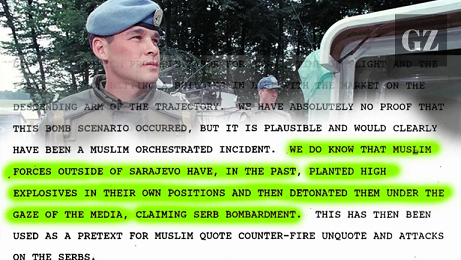
A trove of intelligence files sent by Canadian peacekeepers expose CIA black ops, illegal weapon shipments, imported jihadist fighters, potential false flags, and stage-managed atrocities.
The established mythos of the Bosnian War is that Serb separatists, encouraged and directed by Slobodan Milošević and his acolytes in Belgrade, sought to forcibly seize Croat and Bosniak territory in service of creating an irredentist “Greater Serbia.” Every step of the way, they purged indigenous Muslims in a concerted, deliberate genocide, while refusing to engage in constructive peace talks.
This narrative was aggressively perpetuated by the mainstream media at the time, and further legitimized by the UN-created International Criminal Tribunal for the former Yugoslavia (ICTY) once the conflict ended. It has become axiomatic and unquestionable in Western consciousness ever since, enforcing the sense that negotiation invariably amounts to appeasement, a mentality that has enabled NATO war hawks to justify multiple military interventions over subsequent years.
However, a vast trove of intelligence cables sent by Canadian peacekeeping troops in Bosnia to Ottawa’s National Defence Headquarters, first published by Canada Declassified at the start of 2022, exposes this narrative as cynical farce.
The documents offer an unparalleled, first-hand, real-time view of the war as it developed, with the prospect of peace rapidly degrading into grinding bloodshed that ultimately caused the painful death of the multi-faith, multi-ethnic Yugoslavia.
The Canadian soldiers were part of a wider UN Protection Force (UNPROFOR) dispatched to former Yugoslavia in 1992, in the vain hope tensions wouldn’t escalate to all-out-war, and an amicable settlement could be reached by all sides. They stayed until the bitter end, long past the point their mission was reduced to miserable, life-threatening failure.
The peacekeepers’ increasingly bleak analysis of the reality on the ground provides a candid perspective of the war’s history that has been largely concealed from the public. It is a story of CIA black ops, literally explosive provocations, illegal weapon shipments, imported jihadist fighters, potential false flags, and stage-managed atrocities.
Read the complete Canadian UNPROFOR cables here.
See key excerpts of the files referred to in this article here.
“Outside interference in the peace process”
It is a little-known but openly acknowledged fact that the US laid the foundations for war in Bosnia, sabotaging a peace deal negotiated by the European Community in early 1992. Under its auspices, the country would be a confederation, divided into three semi-autonomous regions along ethnic lines. While far from perfect, each side generally got what it wanted – in particular, self-governance – and at the least, enjoyed an outcome preferable to all-out conflict.
However, on March 28th, 1992, US Ambassador to Yugoslavia Warren Zimmerman met with Bosnian President Alija Izetbegovic, a Bosniak Muslim, to reportedly offer Washington’s recognition of the country as an independent state. He further promised unconditional support in the inevitable subsequent war, if rejected the Community proposal. Hours later, Izetbegovic went on the warpath, and fighting erupted almost immediately.
Received wisdom dictates the Americans were concerned that Brussels’ leading role in negotiations would weaken Washington’s international prestige, and assist in the soon-to-be European Union emerging as an independent power bloc following the collapse of Communism.
While such concerns were no doubt held by US officials, the UNPROFOR cables expose a much darker agenda at work. Washington wanted Yugoslavia reduced to rubble, and planned to bring the Serbs violently to heel by prolonging the war as long as possible. To the US, the Serbs were the ethnic group most determined to preserve the troublesome independent republic’s existence.
These aims were very effectively served by Washington’s absolutist assistance to the Bosniaks. It was an article of faith in the Western mainstream at the time, and remains so today, that Serb intransigence in negotiations blocked the path to peace in Bosnia. Yet, the UNPROFOR cables make repeatedly clear this was not the case.
In cables sent July – September 1993, the time of a ceasefire and renewed attempt to amicably partition the country, the Canadian peacekeepers repeatedly attribute an obstinate character to Bosniaks, not Serbs. As one representative excerpt states, the “insurmountable” goal of “satisfying Muslim demands will be the primary obstacle in any peace talks.”
Various passages also refer to how “outside interference in the peace process” did “not help the situation,” and “no peace” could be achieved “if outside parties continue to encourage the Muslims to be demanding and inflexible in negotiations.”
By “outside” assistance, UNPROFOR of course meant Washington. Its unconditional support for the Bosniaks motivated them to “[negotiate] as if they had won the war,” which they had to date “lost”.
“Encouraging Izetbegovic to hold out for further concessions,” and “clear US desires to lift the arms embargo on the Muslims and to bomb the Serbs are serious obstacles to ending the fighting in the former Yugoslavia,” the peacekeepers recorded on September 7th 1993.
The next day, they reported to headquarters that “Serbs have been the most compliant with the terms of the ceasefire.” Meanwhile, Izetbegovic was basing his negotiating position on “the popular image of the Bosnian Serbs as the bad guys.” Validating this illusion had a concomitant benefit – namely, precipitating NATO airstrikes on Serb areas. This was not lost on the peacekeepers:
“Serious talks in Geneva will not occur as long as Izetbegovic believes that airstrikes will be flown against the Serbs. These airstrikes will greatly strengthen his position and likely make him less cooperative in negotiations.”
Simultaneously, Muslim fighters were “not giving peace talks a chance, just going hell for leather,” and very much willing and able to assist in Izetbegovic’s objective. Throughout the final months of 1993, they launched countless broadsides on Serb territory throughout Bosnia, in breach of the ceasefire.
In December, when Serb forces launched a “major attack” of their own, a cable that month asserted that since early Summer, “most of the Serb activity has been defensive or in response to Muslim provocation.”
A September 13th UNPROFOR cable noted that in Sarajevo, “Muslim forces continue to infiltrate the Mount Igman area and shell BSA [Bosnian Serb Army] positions around the city daily,” the “assessed aim” being to “increase Western sympathy by provoking an incident and blaming the Serbs.”
Two days later, “provocation” of the Bosnian Serb Army (BSA) was continuing, although “the BSA is reported to be exercising restraint.” This area remained a key Bosniak target for some time afterwards. The July – September volume concludes with an ominous cable:
“BSA occupation of Mount Igman is not adversely affecting the situation in Sarajevo. It is simply an excuse for Izetbegovic to delay negotiations. His own troops have been the worst violators [emphasis added] of the [July 30th] ceasefire agreement.”
Enter the Mujahideen: “The Muslims are not above firing on their own people or UN areas”
Throughout the conflict, the Bosnian mujahideen worked ceaselessly to escalate the violence. Muslims from all over the world flooded into the country beginning in the latter half of 1992, waging jihad against the Croats and Serbs. Many had already gained experience on the Afghan battlefield through the 1980’s and early 90’s after arriving from CIA and MI6-infiltrated fundamentalist groups in Britain and the US. For them, Yugoslavia was the next recruitment ground.
The Mujahideen frequently arrived on “black flights”, along with an endless flow of weapons in breach of the UN embargo. This started off as a joint Iranian and Turkish operation, with the financial backing of Saudi Arabia, although as the volume of weapons increased the US took over, flying the deadly cargo to an airport in Tuzla using fleets of C-130 Hercules aircraft.
Estimates of the Bosnian mujahideen’s size vary vastly, but their pivotal contribution to the civil war seems clear. US Balkans negotiator Richard Holbrooke in 2001 declared that Bosniaks “wouldn’t have survived” without their help, and branded their role in the conflict a “pact with the devil” from which Sarajevo was yet to recover.
Mujahideen fighters are never explicitly mentioned in the UNPROFOR cables, and neither are Bosniaks – the term “the Muslims” is used liberally. Still, oblique references to the former are plentiful.
A Winter 1993 intelligence report observed that “the weak and decentralized command and control systems” of the three opposing sides produced “widespread proliferation of weapons and the existence of various official and unofficial paramilitary groups, who often have individual and local agendas.” Among those “unofficial” groups was the Mujahideen, of course.
More clearly, in December that year, the peacekeepers recorded how David Owen, a former British politician who served as the European Community’s lead negotiator in the former Yugoslavia, “had been condemned to death for being responsible for the deaths 0f 130,000 Muslims in Bosnia,” his sentence “passed by the ‘Honour Court of Muslims’.” It was understood that “45 people were in place all over Europe to carry out the sentence.”

Owen certainly wasn’t responsible for the deaths of 130,000 Muslims, as nowhere near that many Bosniaks, Croats, and Serbs were killed over the course of the war in total. Nor were the Bosniaks religious extremists with a network of operatives across the continent, on standby to carry out fatwas passed down by an “Honour Court.”
Subsequent to this incident, which has never previously been publicly revealed, there are reports of “the Muslims” preparing false flag provocations. In January 1994, one cable observed:
“The Muslims are not above firing on their own people or UN areas and then claiming the Serbs are the guilty party in order to gain further Western sympathy. The Muslims often site their artillery extremely close to UN buildings and sensitive areas such as hospitals in the hope that Serb counter-bombardment fire will hit these sites under the gaze of the international media.”

Another cable records how “Muslim troops masquerading as UN forces” had been spotted wearing UNPROFOR’s blue helmets and “a combination of Norwegian and British combat clothing,” driving vehicles painted white and marked UN. The peacekeepers’ Director General feared that if such connivance was to become “widespread” or “be used for infiltration of Croat lines,” it would “greatly increase the prospects for legitimate UN forces to be targeted by the Croats.”