
UN Extends Authority To Manage “Extreme Global Shocks”
Posted By: Jacob Nordangard
The United Nations is a self-proclaimed overseer and caretaker of all humanity. Not content with managing health matters like contrived pandemics, the UN now wants to manage any and every “extreme global shock”. Sustainable Development, aka Technocracy, is resource management, and humans are considered to be resources. — Technocracy News & Trends Editor Patrick Wood
United Nations recently published a policy brief on the twelfth commitment of Our Common Agenda – Emergency Platform. This commitment establishes the need to improve preparedness in more areas besides global health crises (such as pandemics) and will give UN extensive powers in a new crisis situation.
The Emergency Platform would not be a standing body or entity but a set of protocols that could be activated when needed.
The Emergency Platform refers to a set of protocols that are to be activated in the event of a “complex global shock”. When activated the platform brings together leaders from member states, the United Nations, core member groups (such as the G77, G20), international financial institutions (IMF, World Bank), regional organisations (e.g. EU, ASEAN), civil society, the private sector, businesses, research institutes and other experts.
The platform is intended to fulfil the following:
- A rapid, predictable and structured international response
- Maximizing the unique convening role of the United Nations
- Catalysing political leadership through networks of willing Member States;
- Multisectoral, interdisciplinary coordination across the multilateral system
- Multi-stakeholder engagement and accountability in the global response
- Strengthened accountability for delivering against commitments and bringing coherence to the international approach
In the event of a complex shock, all parts of the multilateral system will be held accountable for implementation and act in unison. The platform will “share timely, accurate data, analysis and policy recommendations to support global advocacy and build an international political consensus on the way forward.” A team of technical experts will be working closely with the panel, with staff resources made available “immediately and automatically”.
Since the independence, territory, and political independence of member states may not be violated, according to the UN Charter, it is the responsibility of each nation to do what is required to counteract the effects of the identified crisis on that country’s citizens.
A “complex global shock” is defined as “an event with severely disruptive consequences for a significant proportion of the global population that leads to secondary impacts across multiple sectors”. Examples of crises of this kind are COVID-19 and the increased global cost of living that occurred in 2022 (cost-of-living crisis).
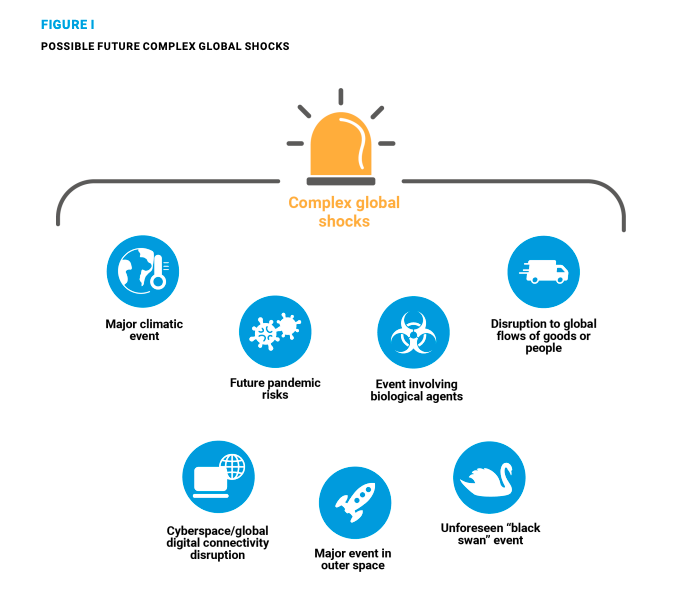
In the overview, United Nations lists seven possible future crises that could justify activating the platform.
- Large-scale climatic or environmental events
- Future pandemics with cascading secondary impacts
- High-impact events involving a biological agent (deliberate or accidental)
- Events leading to disruptions to global flows of goods, people or finance
- Large-scale destructive and/or disruptive activity in cyberspace or disruptions to global digital connectivity
- A major event in outer space that causes severe disruptions to one or several critical systems on Earth
- Unforeseen risks (“black swan” events)
The policy brief states that such global shocks – and the response to them – can lead to restrictions on human rights, including structural discrimination and other inequalities.